Understanding the Role of Leadership in Growth
Explore the role of leadership in growth and understand its importance in fostering success for businesses across Australia.
Understanding the Role of Leadership in Growth
Leadership shapes every corner of a business, turning ordinary goals into unexpected breakthroughs. Many believe success is about resources or strategy alone. Yet, the data tells a different story. Research shows that strong management practices can drive productivity up by as much as 15 percent. Surprised? It gets even better when you realize that leadership is not just about making decisions but about creating the conditions that multiply growth far beyond what numbers on a balance sheet ever show.
Table of Contents
- Defining Leadership And Its Impact On Growth
- The Essence Of Strategic Leadership
- Measuring Leadership's Impact On Organizational Performance
- Why Leadership Is Essential For Business Expansion
- Strategic Decision Making And Growth Trajectory
- Organizational Culture And Performance Acceleration
- The Dynamics Of Leadership Styles In Growth Contexts
- Adaptive Leadership Frameworks
- Motivational Dynamics And Performance
- Key Leadership Practices That Drive Business Growth
- Structured Management And Performance Alignment
- Strategic Performance Optimization
- Real-World Examples Of Leadership Fueling Growth
- Transformative Leadership Strategies
- Breakthrough Organizational Transformation
Quick Summary
TakeawayExplanationEffective leadership directly fuels organizational growthStrong leadership practices correlate with increased productivity and performance, driving substantial business success.Cultivate a culture of innovation and adaptabilityLeaders must create environments that encourage creativity and flexibility to respond to market changes effectively.Focus on strategic vision and executionSuccessful leaders convert long-term goals into actionable plans, ensuring alignment with organizational objectives.Invest in talent development and accountabilityLeaders should prioritize employee growth and establish systems for measuring performance to drive success.Adapt leadership styles to contextTailoring leadership approaches based on specific situational needs enhances effectiveness and organizational responsiveness.
Defining Leadership and Its Impact on Growth
Leadership represents a critical catalyst for organizational growth, extending far beyond traditional management paradigms. At its core, leadership is the strategic ability to inspire, guide, and transform human potential into measurable business outcomes. Understanding the nuanced role of leadership in growth requires examining how exceptional leaders create environments that foster innovation, strategic thinking, and sustainable development.
The Essence of Strategic Leadership
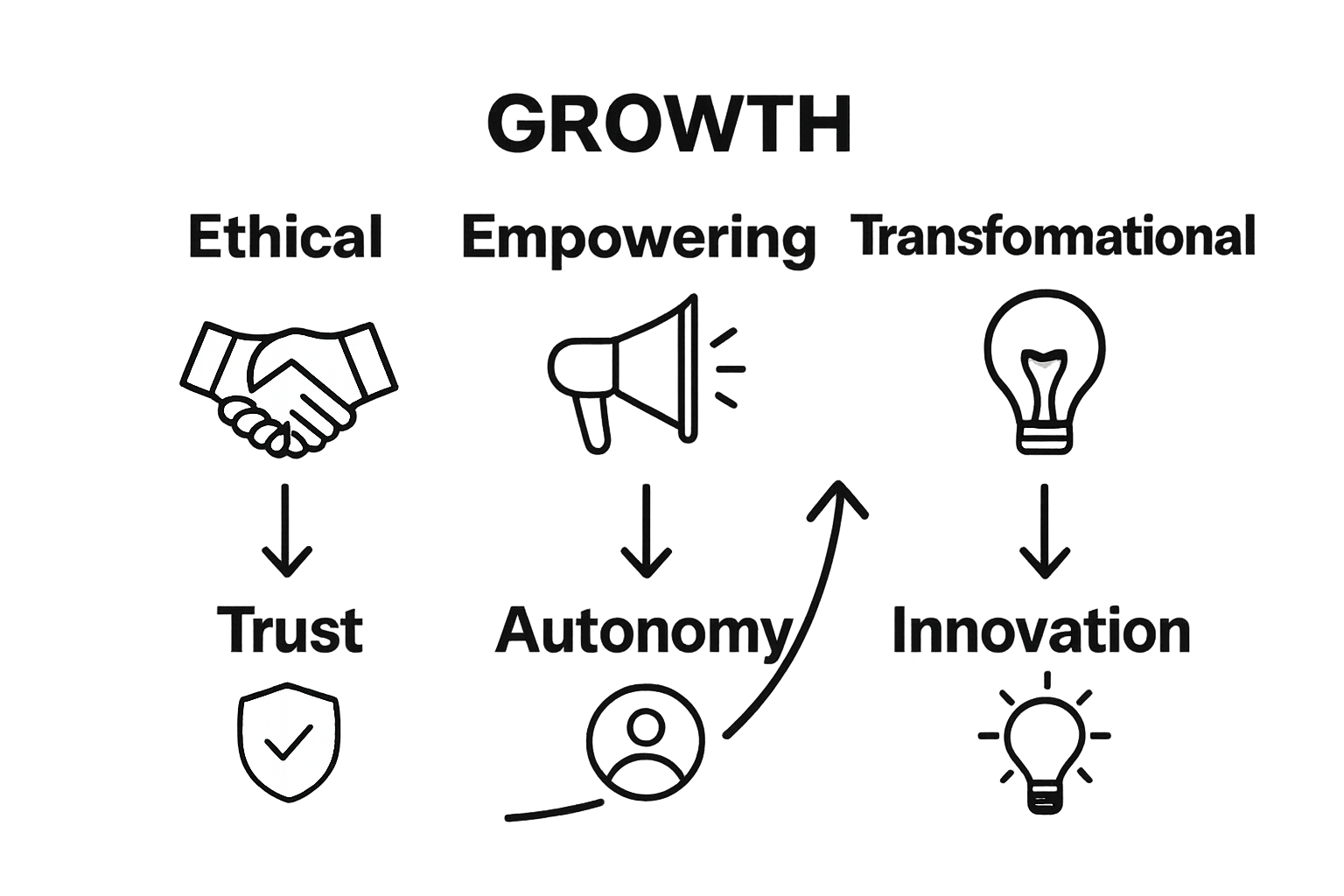
Strategic leadership transcends mere supervision, focusing instead on creating compelling visions that motivate teams toward exceptional performance. According to a comprehensive meta-analysis of leadership styles, different leadership approaches significantly impact organizational motivation and potential. Key leadership dimensions that drive growth include:
- Ethical Leadership: Establishing trust and integrity
- Empowering Leadership: Enabling team autonomy and potential
- Transformational Leadership: Inspiring continuous improvement
These approaches do not simply manage existing resources but actively create conditions for expansion and innovation. By cultivating environments where creativity and strategic thinking are encouraged, leaders unlock collective potential that drives organizational growth.
To clarify and compare key leadership styles mentioned in the article and their distinctive characteristics, see the table below.
Leadership StyleKey CharacteristicsImpact on GrowthEthical LeadershipBuilds trust and integrityEstablishes a trustworthy and values-driven cultureEmpowering LeadershipEnables team autonomy and individual potentialUnlocks motivation and creative problem-solvingTransformational LeadershipInspires continuous improvement and innovationDrives ongoing adaptation and high organizational agilityAdaptive LeadershipAdjusts style based on context and organizational needsOptimizes performance across growth phases
Measuring Leadership's Impact on Organizational Performance
Research demonstrates that effective leadership directly correlates with organizational performance. Empirical studies reveal that superior management practices can account for substantial productivity differences. Economic research examining firm dynamics suggests that high-quality leadership practices can potentially raise economic productivity by up to 15%, highlighting leadership's profound systemic impact.
Leaders who understand this connection focus not just on immediate results but on building sustainable growth mechanisms. They invest in talent development, create robust strategic frameworks, and maintain adaptable organizational cultures that can respond quickly to market changes. By treating human capital as a strategic asset, these leaders transform potential into tangible business outcomes.
Below is a table summarizing notable research data and statistical findings in the article related to leadership and organizational performance.
Research/SourceLeadership Practice/FactorReported Impact on Growth/PerformanceEconomic research on firm dynamicsStrong management practicesCan raise economic productivity by up to 15%CEO performance studiesStrategic leadershipAssociated with approximately 7% higher salesSupervisor quality researchReplacing low-tier with high-tier leadersIncreases team productivity by over 10%U.S. Census Bureau surveys on management practicesStructured leadership approachesDirect impact on productivity, profitability, and growthMicrosoft under Satya NadellaStrategic vision and cultural shiftStock price increased 1,000% and valuation to ~$3 trillion
Why Leadership is Essential for Business Expansion
Business expansion requires more than financial resources or strategic planning. It demands exceptional leadership that can navigate complex challenges, inspire teams, and transform organizational potential into tangible growth. Leadership serves as the critical bridge between existing capabilities and future opportunities, driving businesses beyond incremental progress toward substantial transformation.
Strategic Decision Making and Growth Trajectory
Effective leaders do not merely react to market conditions but proactively shape organizational direction. According to research analyzing CEO performance, leadership behaviors directly correlate with business performance, with strategic leadership approaches associated with approximately 7% higher sales when controlling for existing inputs.
Key strategic decision-making attributes that fuel expansion include:
- Vision Translation: Converting long-term goals into executable strategies
- Risk Assessment: Evaluating potential opportunities with calculated precision
- Resource Optimization: Allocating organizational resources strategically
These attributes enable leaders to identify growth pathways that extend beyond conventional operational boundaries, creating sustainable competitive advantages.
Organizational Culture and Performance Acceleration
Research examining management practices demonstrates that structured leadership approaches directly impact productivity, profitability, and employment growth. Leaders who cultivate adaptive, innovative cultures create environments where teams can consistently outperform market expectations.
Successful business expansion requires leaders who understand that growth is not just about financial metrics but about creating ecosystems where talent can flourish, innovation can emerge, and organizational potential can be fully realized. By investing in human capital, maintaining strategic flexibility, and fostering a culture of continuous learning, leaders transform potential challenges into opportunities for unprecedented growth.
The Dynamics of Leadership Styles in Growth Contexts
Leadership is not a monolithic concept but a dynamic interplay of styles, strategies, and contextual adaptations. Understanding how different leadership approaches influence organizational growth requires nuanced exploration of their unique characteristics and contextual effectiveness. Successful leaders recognize that no single approach universally guarantees success.
Adaptive Leadership Frameworks
Modern growth contexts demand leadership approaches that can flexibly respond to changing organizational needs. Experimental research demonstrates that leadership effectiveness varies significantly depending on specific organizational phases and innovation requirements.
Key adaptive leadership characteristics include:
- Context Sensitivity: Recognizing when different leadership approaches are most appropriate
- Behavioral Flexibility: Shifting leadership styles based on situational demands
- Performance Alignment: Matching leadership approach to specific organizational objectives
This adaptive framework allows leaders to optimize their approach, ensuring maximum performance and innovation potential across different growth stages.
Motivational Dynamics and Performance
Leadership styles profoundly impact team motivation and organizational performance. Research reveals that certain leadership approaches more effectively stimulate intrinsic motivation and innovative behaviors. Different leadership dimensions trigger distinct psychological responses that directly influence organizational capacity for growth.
The most impactful leadership styles demonstrate a sophisticated understanding of human motivation, creating environments where teams are naturally inclined toward high performance. By cultivating leadership approaches that balance inspiration, strategic guidance, and genuine empowerment, organizations can unlock extraordinary potential for sustainable expansion. The most successful leaders understand that growth is not about commanding but about creating conditions where collective potential can be authentically realized.
Key Leadership Practices that Drive Business Growth
Business growth is not an accidental occurrence but a deliberate outcome of strategic leadership practices. Exceptional leaders understand that sustainable expansion requires more than intuition. It demands systematic approaches that transform organizational potential into measurable performance outcomes.
Structured Management and Performance Alignment
Research from U.S. Census Bureau surveys reveals concrete management practices that significantly influence organizational performance. Structured leadership approaches demonstrate remarkable consistency in driving growth across different business contexts.
Critical structured management practices include:
- Performance-Based Talent Management: Promoting and developing employees based on demonstrable abilities
- Clear Target Setting: Establishing both short-term and long-term organizational objectives
- Accountability Mechanisms: Implementing swift responses to performance variations
These practices create an environment where excellence is not just encouraged but systematically cultivated, enabling businesses to transform potential into tangible growth.
Strategic Performance Optimization
Effective leadership transcends traditional management by creating holistic performance ecosystems. Leaders who understand the intricate connections between management practices, employee motivation, and organizational capabilities can strategically optimize growth trajectories.
The most successful leaders recognize that growth is a multidimensional process requiring continuous adaptation. By maintaining flexible yet structured approaches, they create organizational environments where innovation, performance, and strategic alignment naturally emerge. This approach transforms leadership from a supervisory function into a dynamic growth catalyst, enabling businesses to consistently outperform market expectations and achieve sustainable expansion.
Real-World Examples of Leadership Fueling Growth
Theoretical understanding of leadership transforms into tangible impact through practical implementation. Real-world examples demonstrate how visionary leadership can dramatically reshape organizational trajectories, turning potential into extraordinary performance and sustainable growth.
Transformative Leadership Strategies
Research examining supervisor quality reveals concrete evidence of leadership's direct impact on organizational performance. Studies show that replacing a bottom-tier supervisor with a top-tier leader can increase team productivity by over 10%, equivalent to adding an entire team member to a nine-person group.
Key transformative leadership characteristics observed in successful organizations include:
- Strategic Vision: Identifying and pursuing innovative growth pathways
- Cultural Adaptation: Reshaping organizational culture to support continuous improvement
- Performance-Driven Approach: Implementing systematic methods to enhance team capabilities
These characteristics distinguish exceptional leaders who can fundamentally alter organizational potential and performance trajectories.
Breakthrough Organizational Transformation
Companies like Microsoft demonstrate how strategic leadership can drive unprecedented growth. Under CEO Satya Nadella's leadership, the organization underwent a remarkable transformation. By pivoting toward cloud computing and artificial intelligence and implementing a profound cultural shift, Microsoft experienced extraordinary expansion—with its stock price increasing over 1,000% and market valuation reaching approximately $3 trillion.
Successful leaders understand that growth is not about incremental improvements but about creating fundamental shifts in organizational thinking, capabilities, and strategic orientation. They recognize that true leadership transcends management, involving the ability to inspire, reimagine, and systematically execute transformative strategies that unlock unprecedented potential.

Ready to Transform Leadership Into Real Growth for Your Small Business?
Has your business struggled to bridge leadership strategies with day-to-day results? The article reveals that even visionary ideas can stall without clear systems, adaptive leadership, and real support. Many Australian small businesses feel overwhelmed by operational hurdles or uncertain about turning leadership insights into measurable outcomes. If you want to move past just reading about growth and start driving it, Clarity Path Coach is here to help.
Clarity Path Coach empowers you with proven business methodologies and practical systems you can actually implement. Our virtual approach brings clarity, structure, and ongoing support to your business, wherever you are in Australia. Take the next step—visit Clarity Path Coach now to discover how we help small business owners transform leadership potential into sustainable business growth. Let’s unlock your team’s performance and create a culture of innovation. Start today for the momentum your business deserves.
Frequently Asked Questions
What is the role of leadership in organizational growth?
Leadership serves as a critical catalyst for organizational growth by inspiring teams, creating compelling visions, and transforming human potential into measurable outcomes. Effective leaders foster environments that encourage innovation and strategic thinking.
How do different leadership styles impact business performance?
Different leadership styles, such as ethical, empowering, and transformational leadership, significantly impact employee motivation and organizational performance. These approaches help cultivate environments that promote growth and sustainability.
Why is strategic decision-making important for business expansion?
Strategic decision-making is essential for business expansion as it enables leaders to proactively shape organizational direction, evaluate risks, and optimize resource allocation. This method ensures that growth pathways are identified and pursued effectively.
What are some key practices that drive business growth through leadership?
Key practices that drive business growth include performance-based talent management, clear target setting, and accountability mechanisms. These structured management practices create an environment conducive to excellence and tangible growth.
Share this article
Help others discover valuable business insights by sharing this article